

GEO Explained: How to Become the Answer, Not Just the Link
Discover how to optimize for AI-driven search results with GEO.
Solve With Software
TL;DR
GEO, or Generative Engine Optimization, shifts focus from traditional SEO to optimizing content for AI citations. Google's AI Overviews serve over 2 billion users, making GEO essential for visibility.
Key Takeaways
- •Optimize content for AI citations, not just rankings.
- •Focus on clarity and usefulness over backlinks.
- •Structure content with headers and schema markup.
- •AI-driven traffic converts at 27% vs. 2.1% for traditional.
- •Local SEO is crucial for AI recommendations.
Ask ChatGPT something about your industry.
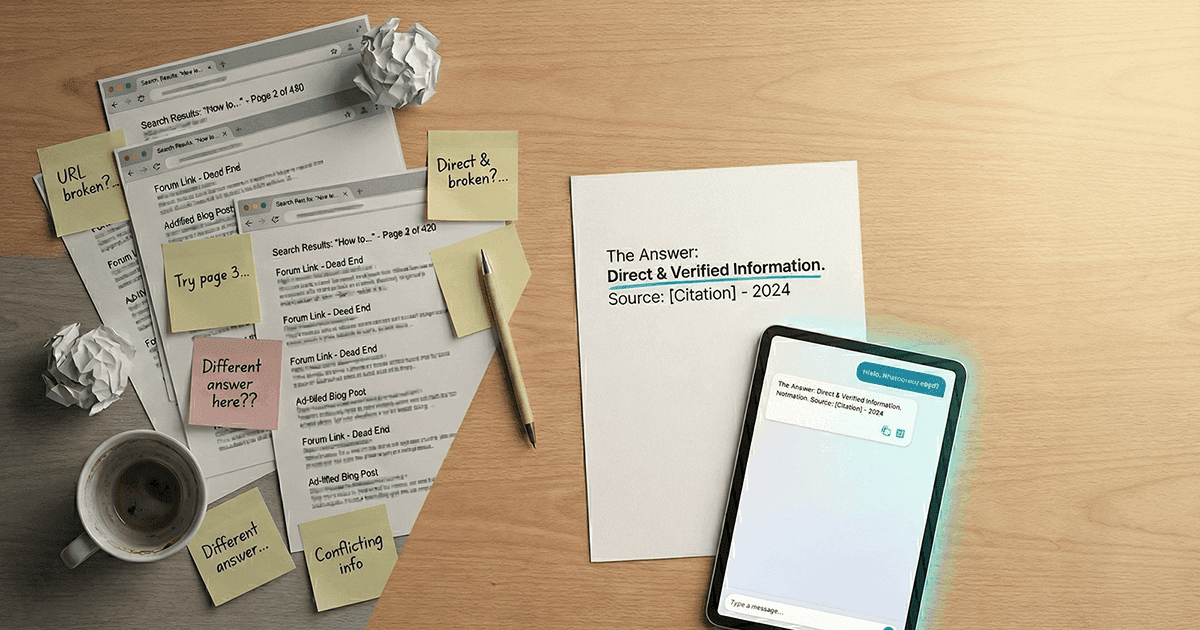
Notice how it just... answered? No list of links. No "here are 10 results." Just an answer, probably citing someone's website you've never heard of.
That citation could be you. Or it could be the competitor you keep losing deals to. That's GEO in a nutshell.
GEO. Another Acronym. (Last One, Promise.)
Generative Engine Optimization. It's what happens when SEO collides with AI-generated search results.
The old game was ranking. Get to page one, get clicks, get business. Simple enough, even if it took years to master.
GEO is different. You're not fighting for position in a list—you're trying to become the source that AI pulls from when someone asks a question. Google's AI Overviews now reach 2 billion users. Two billion. When those users search for something you could help with, AI is summarising answers from somewhere. Might as well be your content.
How Is This Actually Different From SEO?
Okay so traditional SEO: you build backlinks, write meta descriptions, do guest posts, and slowly convince Google you're legitimate. It works. It's slow. It's a grind.
GEO flips the focus. Instead of authority signals and link building, you're optimising for clarity and usefulness. AI systems don't care about your domain authority the way Google's traditional algorithm does. They care whether your content directly answers questions in a way they can easily parse and quote.
I'm not saying SEO is dead. (Everyone who says SEO is dead is selling something.) But if you're only playing the ranking game while ignoring how AI actually finds and uses content, you're leaving money on the table.
Here's the quick version:
| Traditional SEO | GEO | |
|---|---|---|
| Goal | Rank high on a list of links | Be the cited source in AI answers |
| Main metric | Traffic and clicks | Visibility and conversions |
| Content style | Long-form, keyword-focused | Concise, fact-dense, structured |
| How you build authority | Backlinks, domain age | Clarity, relevance, being quotable |
Making Content AI Actually Wants to Cite
This is where agencies charge you thousands for "secrets" that aren't really secrets.
AI systems are trained to find helpful, clear, quotable content. So... write helpful, clear, quotable content. Groundbreaking, I know.
But specifically:
Get to the point faster. AI is looking for direct answers. "What's the best way to reduce invoice processing time?" shouldn't be followed by three paragraphs of waffle before you actually say something useful.
Compare these two openings:
Waffle: "In today's fast-paced business environment, efficiency has become more important than ever. Many companies are looking for ways to streamline their operations..."
Direct: "To reduce invoice processing time, implement OCR software and standardise your approval workflow. Most businesses see a 40% reduction in processing time."
The second one gives AI something it can actually use.
Structure isn't optional anymore. Headers, subheadings, clear sections. Not because it looks pretty—because AI uses structure to understand what your content is actually about. A wall of text with no formatting is basically invisible.
Schema markup. Yeah, this is technical. Basically it's code that tells AI "this is a how-to guide" or "this is a product review." If you don't have it, get your developer to add it. If you don't have a developer, Merkle has a free generator. Takes about twenty minutes.
Stop keyword stuffing. Seriously. AI is trained on content humans found useful. Garbage written for algorithms reads like garbage to AI too.
The annoying truth? Good GEO looks a lot like good content marketing. No shortcuts.
Fewer Visitors, Better Visitors
This stat genuinely surprised me: visitors who come from AI citations convert at 27%. Normal search traffic? 2.1%.
Think about why. Someone clicking through from an AI recommendation has already been pre-qualified. The AI said "this business knows what they're talking about" and the person trusted it. They're not comparison shopping. They're not bouncing between ten tabs. They showed up ready to engage.
So maybe obsessing over raw traffic numbers is the wrong metric.
There's also the visibility angle. Even when people don't click through, being cited in AI responses puts your name in front of them. You become the source. Over time, that compounds.
Local Matters More Than You'd Think
Most of us aren't competing globally. You're an accountant in Colchester or a plumber in Ipswich or whatever. AI is getting scarily good at local recommendations.
"Best solicitor near me" used to give you a map with some pins. Now it might give you a specific recommendation with reasoning.
Three things matter here:
Your Google Business Profile needs to be complete and current. Not "I filled it in three years ago" complete. Actually current. Hours, photos, services, the lot.
Reviews—and not just star ratings. AI parses the actual text of reviews looking for specifics. "Great service" means nothing. "They handled our probate case quickly and kept us informed throughout" gives AI something to work with.
Local content that's actually local. Mentioning your town once in the footer doesn't count. Write about local stuff. Reference local challenges. Show you understand the actual area you serve.
Tools (Without the Sales Pitch)
Clearscope and Surfer SEO are good for understanding what's currently ranking in AI-favoured positions. They cost around £150-200 a month, which isn't nothing.
Honestly though? Just ask ChatGPT questions about your industry and see who gets cited. If it's never you, start figuring out why. That's free and surprisingly illuminating.
Some agencies now specialise specifically in this stuff. Whether you need one depends on your budget and how quickly you want to move. You can absolutely DIY this for a while.
Tracking Whether Any of This Works
Traditional analytics don't capture GEO success very well. Traffic might go down while conversions go up. Visibility might increase without clear attribution.
What to watch: Are you showing up in AI responses? (Test this manually.) What's your conversion rate from organic traffic? Is brand search volume increasing?
Some businesses report 45% increases in organic traffic and 38% lifts in e-commerce revenue from GEO focus. I'd take specific numbers with a pinch of salt—results vary wildly. But the direction is consistent. Better visibility in AI leads to better business outcomes.
Combining this with traditional SEO (not replacing it) seems to work best for most businesses. Belt and braces.
Right, So Now What?
Either look at improvements you can make to your current website, or contact us to learn about our brand-new GEO Business Website solution we have just launched (Jan, 2026).
Start with your most important pages—the ones that actually drive business. Make them clearer. Add structure. Answer questions directly instead of dancing around them.
Most of your competitors are still fighting for rankings while ignoring where search is actually going. Now is your window.
Enquire about our GEO Business Website solutions.
Get in touch with us today
Frequently Asked Questions
How can I optimize content for AI citations?
Ensure content is clear, concise, and structured with headers and schema markup for AI parsing.
What role does local SEO play in GEO?
Local SEO helps AI systems provide accurate local recommendations, enhancing visibility in local searches.
Does Solve With Software Ltd provide GEO/SEO services?
Yes, we have our own platform built from the ground up (this website uses it!) to help SMEs to benefit from advanced GEO/SEO features.
Why is AI-driven traffic more valuable?
AI-driven traffic converts at a higher rate because users are pre-qualified by AI recommendations.
How does GEO differ from traditional SEO?
GEO focuses on clarity and usefulness for AI systems, rather than backlinks and domain authority.
What is Generative Engine Optimization?
GEO is the process of optimizing content to be the source AI systems cite in their responses.
About Solve With Software
Expert insights on software development, AI, and digital transformation from the Solve With Software team.
More in Website Design
See all...
9 Proven Ways to Drive More Traffic to Your Small Business Website
Struggling to get high-quality visitors? Discover nine proven ways to drive traffic to your small business website and see real growth.
Do you design websites?
Looking for a custom website? Our Colchester-based team creates bespoke sites tailored to your business needs.

Make Your Website Work Harder in 2026
Is your business website outdated? Discover how AI and dynamic content can transform it in 2026, boosting engagement and ROI.

Contact Forms Should Be a Last Resort During Working Hours
Contact forms often fail during work hours. Learn how live chat can capture leads effectively without waiting.